

Friday, September 26, 2008


Wednesday, September 24, 2008
India and the ILO
India is a founder member of the International Labour Organization, which came into existence in 1919. At present the ILO has 175 Members. A unique feature of the ILO is its tripartite character. The membership of the ILO ensures the growth of tripartite system in the Member countries. At every level in the Organization, Governments are associated with the two other social partners, namely the workers and employers. All the three groups are represented on almost all the deliberative organs of the ILO and share responsibility in conducting its work. The three organs of the ILO are:
International Labour Conferences: - General Assembly of the ILO – Meets every year in the month of June.
Governing Body: - Executive Council of the ILO. Meets three times in a year in the months of March, June and November.
International Labour Office: - A permanent secretariat.
The work of the Conference and the Governing Body is supplemented by Regional Conferences, Regional Advisory Committees, Industrial and Analogous Committees, Committee of Experts, Panels of Consultants, Special Conference and meetings, etc.
INTERNATIONAL LABOUR CONFERENCE
Except for the interruption caused by the Second World War, the international Labour Conference has continued, since its first session in 1919 to meet at least once a year. The Conference, assisted by the Governing Body, adopts biennial programme and budget, adopts International Labour Standards in the form of Conventions and Recommendations and provides a forum for discussing social economic and labour related issues. India has regularly and actively participated in the Conference through its tripartite delegations.
The Conference has so far had 4 Indian Presidents viz., Sir. Atul Chatterjee (1927), Shri Jagjivan Ram, Minister for Labour (1950), Dr. Nagendra Singh, President, International Court of Justice (1970) and Shri Ravindra Verma, Minister of Labour and Parliamentary Affairs (1979). There have also been 8 Indian Vice Presidents of the International Labour Conference, 2 from the Government group, 3 from the Employers and 3 from the Workers’ Group. Indians have chaired the important Committees of the Conferences like Committee on Application of Standards, Selection Committee and Resolutions Committee.
GOVERNING BODY
The Governing Body of the ILO is the executive wing of the Organization. It is also tripartite in character. Since 1922 Indian has been holding a non-elective seat on the Governing Body as one of the 10 countries of chief industrial importance. Indian employers and workers’ representatives have been elected as Members of the Governing Body from time to time.
Four Indians have so far been elected Chairman of the Governing Body. They are Sir Atul Chatterjee (1932-33), Shri Shamal Dharee Lall, Secretary, Ministry of Labour (1948-49), Shri S.T. Merani, Joint Secretary, Ministry of Labour (1961-62) and Shri B.G. Deshmukh, Secretary, Ministry of Labour (1984-85).
The Governing Body of ILO functions through its various Committees. India is a member of all six committees of the Governing Body viz. (i) Programme, Planning & Administrative; (ii) Freedom of Association; (iii) Legal Issues and International Labour Standards; (iv) Employment & Social Policy; (v) Technical Cooperation and (vi) Sectoral and Technical Meetings and Related issues.
THE INTERNATIONAL LABOUR OFFICE
The International Labour Office, Geneva provides the Secretariat for all Conferences and other meetings and is responsible for the day-to-day implementation of decisions taken by the Conference, Governing Body etc. Indians have held positions of importance in the International Labour Office. Special mention must be made of Shri S.K. Jain who retired as Deputy Director General of the ILO. Shri Gopinath is currently the Director International Institute of Labour Studies, Geneva.
INTERNATIONAL LABOUR STANDARDS - ILO CONVENTIONS: -
The principal means of action in the ILO is the setting up the International Labour Standards in the form of Conventions and Recommendations. Conventions are international treaties and are instruments, which create legally binding obligations on the countries that ratify them. Recommendations are non-binding and set out guidelines orienting national policies and actions.
Pakistan (34), Japan (45), Australia (57), China (20), Malaysia (14), Sri Lanka (39) and USA (14).
The approach of India with regard to International Labour Standards has always been positive. The ILO instruments have provided guidelines and useful framework for the evolution of legislative and administrative measures for the protection and advancement of the interest of labour. To that extent the influence of ILO Conventions as a standard for reference for labour legislation and practices in India, rather than as a legally binding norm, has been significant. Ratification of a Convention imposes legally binding obligations on the country concerned and, therefore, India has been careful in ratifying Conventions. It has always been the practice in India that we ratify a Convention when we are fully satisfied that our laws and practices are in conformity with the relevant ILO Convention. It is now considered that a better course of action is to proceed with progressive implementation of the standards, leave the formal ratification for consideration at a later stage when it becomes practicable. We have so far ratified 39 Conventions of the ILO, which is much better than the position obtaining in many other countries. Even where for special reasons, India may not be in a position to ratify a Convention, India has generally voted in favour of the Conventions reserving its position as far as its future ratification is concerned.
Core Conventions of the ILO: - The eight Core Conventions of the ILO (also called fundamental/human rights conventions) are:
Forced Labour Convention (No. 29)
Abolition of Forced Labour Convention (No.105)
Equal Remuneration Convention (No.100)
Discrimination (Employment Occupation) Convention (No.111)
(The above four have been ratified by India).
Freedom of Association and Protection of Right to Organised Convention (No.87)
Right to Organise and Collective Bargaining Convention (No.98)
Minimum Age Convention (No.138)
Worst forms of Child Labour Convention (No.182) (These four are yet to be ratified by India)
Consequent to the World Summit for Social Development in 1995, the above-mentioned Conventions (Sl.No. 1 to 7) were categorised as the Fundamental Human Rights Conventions or Core Conventions by the ILO. Later on, Convention No.182 (Sl.No.8) was added to the list.
As per the Declaration on Fundamental Principles and Rights at Work and its Follow-up, each member State of the ILO is expected to give effect to the principles contained in the Core Conventions of the ILO, irrespective of whether or not the Core Conventions have been ratified by them.
Under the reporting procedure of the ILO, detailed reports are due from the member States that have ratified the priority Conventions and the Core Conventions every two years. Under the Follow-up to the ILO Declaration on Fundamental Principles and Rights at Work, a report is to be made by each member State every year on those Core Conventions that it has not yet ratified.
REASONS FOR NON-RATIFICATION:
CONVENTIONS NO.87 AND 98:
Convention No.87 provides for the right of workers and employers, without any distinction to establish and join organizations of their own choosing without previous authorisation. Their organizations have the right to form or join federations and confederations, including on the international level. These organizations or federations may not be liable to arbitrary dissolution or suspension by an administrative authority. The only exception provided for in the Convention to the right to organise “without distinction whatsoever” are the armed forces and the police, to whom special rules and regulations may apply. Convention No.98 aims to protect the exercise of the right to organise and to promote voluntary collective bargaining. The guarantees provided for under these two Conventions are by and large available to workers in India by means of constitutional provisions, laws and regulations and practices. The main reason for our not ratifying these two Conventions is the inability of the Government to promote unionisation of the Government servants in a highly politicised trade union system of the country. Freedom of expression, freedom of association and functional democracy are guaranteed by our Constitution. The Government has promoted and implemented the principles and rights envisaged under these two Conventions in India and the workers are exercising these rights in a free and fare democratic society. Our Constitution guarantees job security, social security and fair working conditions and fair wages to the Government servants. They have also been provided with alternative grievance redressal mechanisms like Joint Consultative Machinery, Central Administrative Tribunal etc. Hence, our stand has been that this section of the workforce cannot be said to have been deprived of the right of association.
CONVENTION NO.138
As of now, there is no omnibus provision in our labour laws prohibiting children below certain age from doing any work whatsoever. For ratifying Convention No.138, enactment of a suitable all encompassing Central Legislation for minimum age of entry to employment would need to be enacted to have provisions for:
(a) fixing a minimum age of 14 years for admission to employment or work in all occupations, employment and work but excluding agriculture in family and small holdings producing for own consumptions and not regularly employing hired workers; and
(b) fixing a minimum age of not less than 18 years for admission to any type of employment or work which by its nature or circumstances in which it is carried out is likely to jeopardise the health, safety or morals of young persons.
The definition of ‘child’ in all concerned existing legislations would then need to be determined in accordance with the provisions of the Central Legislation on minimum age for admission to employment. Thus, the Bill on the above lines on its enactment was to replace or supercede the concerned existing legislations like the Child Labour (Prohibition and Regulation) Act, 1986 etc.
Fixing of minimum age for admission to employment needs to be preceded by creation of suitable enforcement machinery and measures as would warrant the children not being compelled by circumstances to seek employment. The setting up of such machinery, particularly, for the unorganised sector in agriculture, cottage and small-scale industries etc., (except for those industries which are covered under the Factories Act) becomes a difficult task in a developing country like India.
In the background of the above position, consultations have been held with the concerned Ministries/Departments and State Governments to examine the existing provisions of national laws and practices on the subject vis-à-vis the provisions of the Convention. Since there is no omnibus law on minimum age for entry into employment and the existing laws prescribe different minimum ages for different sectors, the process is likely to be long drawn.
CONVENTION NO.182:
Ratification of Convention No.182 concerning Worst Forms of Child Labour is being pursued by the ILO with all member countries. The ILO has also initiated a concerted campaign for this purpose. India is examining the feasibility of ratifying this convention in consultation with the concerned Central Ministries and State Governments. This is also to be discussed in a tripartite forum with the participation of the Employers and Workers Representatives.
Action taken so far:
Ø Consultation meeting taken by Secretary (Labour) on 3rd July, 2001 with the representatives of Central Ministries/Departments and selected State Governments: In this meeting it was felt that there would not be any objection to agreeing to the elimination of worst forms of child labour is defined in Article 3(a), (b) and (c). In this connection, the concerned Ministries have been approached and they have also agreed to amend the existing Acts in such a manner as to bring them in line with the definitions in Convention No.182. It was felt that Article 3(d) of the Convention was more omnibus and less definitive in its nature. The work defined under this clause would need to be decided through the tripartite mechanisms as defined in Article 4 of the Convention.
Ø Tripartite meeting of the Tripartite Committee on Conventions on 19th October, 2001: The meeting decided that the provisions of Article 3(a),(b)&(c) of Convention No.182 were acceptable as given in the text. As far as the provision of Article 3(d) was concerned, wherein the Tripartite consultation mechanism was required to identify hazardous occupations and processes, the Technical Advisory Committee constituted under the Child Labour (Prohibition and Abolition) Act would be requested to examine the list of hazardous activities and identify the occupations and processes that were likely to harm the health, safety and morals of children as defined in Article 3(d) of Convention No.182. The matter would then be placed before the next tripartite meeting, by which time the report of the Second National Labour Commission was also expected to be available. The views of the social partners on the list of hazardous occupations identified by the Technical Advisory Committee would also be elicited before the next meeting is convened.
ILO AREA OFFICE, NEW DELHI
An ILO Branch Office was set up in New Delhi in 1929. The work of the Branch Office consisted of collecting and disseminating information and maintaining links with the Government of India and the Organizations of Employers and Workers and generally to publicise the work of ILO among the Indian audience. With the planned programme of decentralisation, the Branch Office became an Area Office of ILO in 1970. The Area Office at New Delhi has been changing in its jurisdiction over the years. It now coordinates technical assistance activities in diverse focus as such as rural Labour, women workers, employment generation, occupational safety and health, population control, family welfare, etc. in India and Bhutan.
ILO COMMITTEE OF EXPERTS
Prominent Indians have served on the ILO Committee of Experts on Application of Conventions and Recommendations, which is an independent body to oversee the implementation of the ILO Conventions by Member countries. The Members of the Committee of Experts are appointed in their individual capacity from among persons of independent, standing and are drawn from all parts of the world. Indian who have been members of the Committee include:
Justice P.N. Bhagwati, Retd. Chief Justice of India - Since 1978.
Justice P.V. Gajendragadkar - 1972-1977
Shri A. Ramaswamy Mudaliar - 1959-1970
Shri R.M. Bannerjee - 1956-1988
Shri Atul Chatterjee - 1936-1938 & 1945-1955.
ACTIVE PARTNERSHIP POLICY & MULTI-DISCIPLINARY TEAM
One of the major reforms initiated recently is the launching of the “Active Partnership Policy” whose aim is to bring ILO closer to its constituents. The main instrument for implementation of the policy – is the multi-disciplinary team, which will help identify special areas of concern and provide technical advisory services to member States to translate ILO’s core mandate into action. The multi-disciplinary team for South-Asia is based in New Delhi. It consists of specialists on employment, industrial relations, workers and employers’ activity, small-scale enterprises and International Labour Standards.
ILO AND CHILD LABOUR
ILO’s interest in child labour, young persons and their problems is well known. It has adopted a number of Conventions and Recommendations in this regard. In India, within a framework of the Child Labour (Prohibition and Regulations) Act, 1986 and through the National Policy on Child Labour, ILO has funded the preparation of certain local and industry specific projects. In two kanor projects, viz. Child Labour Action and Support Programmes (CLASP) and International Programme on Elimination of Child Labour (IPEC), the ILO is playing a vital role.
The implementation of IPEC programmes in India has certainly created a very positive impact towards understanding the problem of child labour and in highlighting the need to elimination child labour as expeditiously as possible. A major contribution of the IPEC programme in India is that it has generated a critical consciousness among all the 3 social partners for taking corrective measures to eliminate child labour.
DECENT WORK
The concept of Decent Work is being propagated by the ILO. It encompasses four strategic objectives –
I. Promotion of Rights at Work - It calls for renewed attention to ILO’s standards, as well as a fresh look at complimentary means and instruments for achieving this goal.
II. Employment - Creation of greater employment and income opportunities for women and men as a means to reduce poverty and inequality.
III. Social Protection – This section emphasises expansion of social security schemes.
IV. Social Dialogue – This emphasises examining ways of strengthening the institutional capacity of ILO constituents as well as their contribution to the process of dialogue.
The concept of Decent Work emphasises that the quantity of employment should not be divorced from quality of work and stresses that a social and economic system should be evolved to ensure basic security and employment without compromising workers’ rights and social standards in a highly competitive world.
Although India agrees that the four strategic objectives are necessary for decent work, this has no meaning unless we can provide an opportunity to work. Therefore, employment generation should be the focus of the all ILO programmes and activities. The basic requirement of Decent Work should be to first ensure work to any potential worker and then all other elements of the decent work concept will automatically follow. This stand of India was appreciated by other nations as well. India also made it clear in the meetings of the ILO that the concept of decent work has to be fixed keeping in mind the conditions of work in the social, economic and cultural context of each country. It cannot be made applicable uniformly to every country.
Linkage between trade and labour standards:
The issue of linkage between trade and labour standards was first raised at the conclusions of the Uruguay Round at Marrakesh in 1994 by the USA. India and other developing countries had taken the position that labour standards at the international levels can be appropriately addressed only in the ILO, not in the WTO. The social clause is not within the mandate of the WTO. In response, India had countered that the relationship between trade and immigration policies may also be examined in the WTO. The issue was not pursued seriously by the US for sometime thereafter.
The issue again came up at the First Ministerial Conference of the WTO in Singapore in 1996. In this Conference, developing countries including India once again rejected the proposal of the US to include labour standards as an agenda in the WTO. The final Ministerial Declaration at Singapore endorsed the stand of the developing countries and reiterated the following:
i. ILO is the competent body to set and deal with core labour standards and WTO affirms its support in promoting such standards.
ii. It rejected the use of labour standards for protectionist purposes and agreed that the comparative advantage of countries, particularly low wage developing countries, must in no way be put into question.
iii. It noted that the WTO and ILO Secretariats would continue their existing collaboration.
The Ministerial Declaration at Singapore was seen by the developing countries as a successful heading off of further moves towards linkage between trade and labour standards and confining discussions within the ILO.
In the Third WTO Ministerial Conference held at Seattle in 1999, the US had proposed establishment of a Working Group on Trade and Labour, which would deal with issues such as trade and employment, trade and social protection, core labour standards, forced and child labour, etc. and submits a report for consideration at the Fourth Ministerial Conference. The European Union proposed the establishment of a joint ILO-WTO Working Forum on trade, globalisation and labour issues to promote better understanding of the issues involved through a substantial dialogue between all interested parties including governments, employers, trade unions and other international organizations. There was no conclusive outcome from this Conference, which attracted much criticism and demonstrations by NGOs and other activist groups.
The Fourth Ministerial Conference of the WTO, which was held in Doha from 9th to 14th November 2001, reaffirmed the Declaration made at the Singapore Ministerial Conference of the WTO that ILO is the appropriate forum to set and deal with the issues of core labour standards.
India’s future stands on linkages issue
India will continue to adhere to the stand that all matters related to international labour standards are to be agitated only in the relevant forum of the ILO and that the comparative advantage of countries, particularly developing countries, must in no way be put into question। India will continue to reject the use of labour standards for protectionist purposes and any attempt to link labour standards with trade will be vehemently opposed invariably, even if isolated by other countries।
Source: http://labour.nic.in/ilas/indiaandilo.htm
India is a founder member of the International Labour Organization, which came into existence in 1919. At present the ILO has 175 Members. A unique feature of the ILO is its tripartite character. The membership of the ILO ensures the growth of tripartite system in the Member countries. At every level in the Organization, Governments are associated with the two other social partners, namely the workers and employers. All the three groups are represented on almost all the deliberative organs of the ILO and share responsibility in conducting its work. The three organs of the ILO are:
International Labour Conferences: - General Assembly of the ILO – Meets every year in the month of June.
Governing Body: - Executive Council of the ILO. Meets three times in a year in the months of March, June and November.
International Labour Office: - A permanent secretariat.
The work of the Conference and the Governing Body is supplemented by Regional Conferences, Regional Advisory Committees, Industrial and Analogous Committees, Committee of Experts, Panels of Consultants, Special Conference and meetings, etc.
INTERNATIONAL LABOUR CONFERENCE
Except for the interruption caused by the Second World War, the international Labour Conference has continued, since its first session in 1919 to meet at least once a year. The Conference, assisted by the Governing Body, adopts biennial programme and budget, adopts International Labour Standards in the form of Conventions and Recommendations and provides a forum for discussing social economic and labour related issues. India has regularly and actively participated in the Conference through its tripartite delegations.
The Conference has so far had 4 Indian Presidents viz., Sir. Atul Chatterjee (1927), Shri Jagjivan Ram, Minister for Labour (1950), Dr. Nagendra Singh, President, International Court of Justice (1970) and Shri Ravindra Verma, Minister of Labour and Parliamentary Affairs (1979). There have also been 8 Indian Vice Presidents of the International Labour Conference, 2 from the Government group, 3 from the Employers and 3 from the Workers’ Group. Indians have chaired the important Committees of the Conferences like Committee on Application of Standards, Selection Committee and Resolutions Committee.
GOVERNING BODY
The Governing Body of the ILO is the executive wing of the Organization. It is also tripartite in character. Since 1922 Indian has been holding a non-elective seat on the Governing Body as one of the 10 countries of chief industrial importance. Indian employers and workers’ representatives have been elected as Members of the Governing Body from time to time.
Four Indians have so far been elected Chairman of the Governing Body. They are Sir Atul Chatterjee (1932-33), Shri Shamal Dharee Lall, Secretary, Ministry of Labour (1948-49), Shri S.T. Merani, Joint Secretary, Ministry of Labour (1961-62) and Shri B.G. Deshmukh, Secretary, Ministry of Labour (1984-85).
The Governing Body of ILO functions through its various Committees. India is a member of all six committees of the Governing Body viz. (i) Programme, Planning & Administrative; (ii) Freedom of Association; (iii) Legal Issues and International Labour Standards; (iv) Employment & Social Policy; (v) Technical Cooperation and (vi) Sectoral and Technical Meetings and Related issues.
THE INTERNATIONAL LABOUR OFFICE
The International Labour Office, Geneva provides the Secretariat for all Conferences and other meetings and is responsible for the day-to-day implementation of decisions taken by the Conference, Governing Body etc. Indians have held positions of importance in the International Labour Office. Special mention must be made of Shri S.K. Jain who retired as Deputy Director General of the ILO. Shri Gopinath is currently the Director International Institute of Labour Studies, Geneva.
INTERNATIONAL LABOUR STANDARDS - ILO CONVENTIONS: -
The principal means of action in the ILO is the setting up the International Labour Standards in the form of Conventions and Recommendations. Conventions are international treaties and are instruments, which create legally binding obligations on the countries that ratify them. Recommendations are non-binding and set out guidelines orienting national policies and actions.
Pakistan (34), Japan (45), Australia (57), China (20), Malaysia (14), Sri Lanka (39) and USA (14).
The approach of India with regard to International Labour Standards has always been positive. The ILO instruments have provided guidelines and useful framework for the evolution of legislative and administrative measures for the protection and advancement of the interest of labour. To that extent the influence of ILO Conventions as a standard for reference for labour legislation and practices in India, rather than as a legally binding norm, has been significant. Ratification of a Convention imposes legally binding obligations on the country concerned and, therefore, India has been careful in ratifying Conventions. It has always been the practice in India that we ratify a Convention when we are fully satisfied that our laws and practices are in conformity with the relevant ILO Convention. It is now considered that a better course of action is to proceed with progressive implementation of the standards, leave the formal ratification for consideration at a later stage when it becomes practicable. We have so far ratified 39 Conventions of the ILO, which is much better than the position obtaining in many other countries. Even where for special reasons, India may not be in a position to ratify a Convention, India has generally voted in favour of the Conventions reserving its position as far as its future ratification is concerned.
Core Conventions of the ILO: - The eight Core Conventions of the ILO (also called fundamental/human rights conventions) are:
Forced Labour Convention (No. 29)
Abolition of Forced Labour Convention (No.105)
Equal Remuneration Convention (No.100)
Discrimination (Employment Occupation) Convention (No.111)
(The above four have been ratified by India).
Freedom of Association and Protection of Right to Organised Convention (No.87)
Right to Organise and Collective Bargaining Convention (No.98)
Minimum Age Convention (No.138)
Worst forms of Child Labour Convention (No.182) (These four are yet to be ratified by India)
Consequent to the World Summit for Social Development in 1995, the above-mentioned Conventions (Sl.No. 1 to 7) were categorised as the Fundamental Human Rights Conventions or Core Conventions by the ILO. Later on, Convention No.182 (Sl.No.8) was added to the list.
As per the Declaration on Fundamental Principles and Rights at Work and its Follow-up, each member State of the ILO is expected to give effect to the principles contained in the Core Conventions of the ILO, irrespective of whether or not the Core Conventions have been ratified by them.
Under the reporting procedure of the ILO, detailed reports are due from the member States that have ratified the priority Conventions and the Core Conventions every two years. Under the Follow-up to the ILO Declaration on Fundamental Principles and Rights at Work, a report is to be made by each member State every year on those Core Conventions that it has not yet ratified.
REASONS FOR NON-RATIFICATION:
CONVENTIONS NO.87 AND 98:
Convention No.87 provides for the right of workers and employers, without any distinction to establish and join organizations of their own choosing without previous authorisation. Their organizations have the right to form or join federations and confederations, including on the international level. These organizations or federations may not be liable to arbitrary dissolution or suspension by an administrative authority. The only exception provided for in the Convention to the right to organise “without distinction whatsoever” are the armed forces and the police, to whom special rules and regulations may apply. Convention No.98 aims to protect the exercise of the right to organise and to promote voluntary collective bargaining. The guarantees provided for under these two Conventions are by and large available to workers in India by means of constitutional provisions, laws and regulations and practices. The main reason for our not ratifying these two Conventions is the inability of the Government to promote unionisation of the Government servants in a highly politicised trade union system of the country. Freedom of expression, freedom of association and functional democracy are guaranteed by our Constitution. The Government has promoted and implemented the principles and rights envisaged under these two Conventions in India and the workers are exercising these rights in a free and fare democratic society. Our Constitution guarantees job security, social security and fair working conditions and fair wages to the Government servants. They have also been provided with alternative grievance redressal mechanisms like Joint Consultative Machinery, Central Administrative Tribunal etc. Hence, our stand has been that this section of the workforce cannot be said to have been deprived of the right of association.
CONVENTION NO.138
As of now, there is no omnibus provision in our labour laws prohibiting children below certain age from doing any work whatsoever. For ratifying Convention No.138, enactment of a suitable all encompassing Central Legislation for minimum age of entry to employment would need to be enacted to have provisions for:
(a) fixing a minimum age of 14 years for admission to employment or work in all occupations, employment and work but excluding agriculture in family and small holdings producing for own consumptions and not regularly employing hired workers; and
(b) fixing a minimum age of not less than 18 years for admission to any type of employment or work which by its nature or circumstances in which it is carried out is likely to jeopardise the health, safety or morals of young persons.
The definition of ‘child’ in all concerned existing legislations would then need to be determined in accordance with the provisions of the Central Legislation on minimum age for admission to employment. Thus, the Bill on the above lines on its enactment was to replace or supercede the concerned existing legislations like the Child Labour (Prohibition and Regulation) Act, 1986 etc.
Fixing of minimum age for admission to employment needs to be preceded by creation of suitable enforcement machinery and measures as would warrant the children not being compelled by circumstances to seek employment. The setting up of such machinery, particularly, for the unorganised sector in agriculture, cottage and small-scale industries etc., (except for those industries which are covered under the Factories Act) becomes a difficult task in a developing country like India.
In the background of the above position, consultations have been held with the concerned Ministries/Departments and State Governments to examine the existing provisions of national laws and practices on the subject vis-à-vis the provisions of the Convention. Since there is no omnibus law on minimum age for entry into employment and the existing laws prescribe different minimum ages for different sectors, the process is likely to be long drawn.
CONVENTION NO.182:
Ratification of Convention No.182 concerning Worst Forms of Child Labour is being pursued by the ILO with all member countries. The ILO has also initiated a concerted campaign for this purpose. India is examining the feasibility of ratifying this convention in consultation with the concerned Central Ministries and State Governments. This is also to be discussed in a tripartite forum with the participation of the Employers and Workers Representatives.
Action taken so far:
Ø Consultation meeting taken by Secretary (Labour) on 3rd July, 2001 with the representatives of Central Ministries/Departments and selected State Governments: In this meeting it was felt that there would not be any objection to agreeing to the elimination of worst forms of child labour is defined in Article 3(a), (b) and (c). In this connection, the concerned Ministries have been approached and they have also agreed to amend the existing Acts in such a manner as to bring them in line with the definitions in Convention No.182. It was felt that Article 3(d) of the Convention was more omnibus and less definitive in its nature. The work defined under this clause would need to be decided through the tripartite mechanisms as defined in Article 4 of the Convention.
Ø Tripartite meeting of the Tripartite Committee on Conventions on 19th October, 2001: The meeting decided that the provisions of Article 3(a),(b)&(c) of Convention No.182 were acceptable as given in the text. As far as the provision of Article 3(d) was concerned, wherein the Tripartite consultation mechanism was required to identify hazardous occupations and processes, the Technical Advisory Committee constituted under the Child Labour (Prohibition and Abolition) Act would be requested to examine the list of hazardous activities and identify the occupations and processes that were likely to harm the health, safety and morals of children as defined in Article 3(d) of Convention No.182. The matter would then be placed before the next tripartite meeting, by which time the report of the Second National Labour Commission was also expected to be available. The views of the social partners on the list of hazardous occupations identified by the Technical Advisory Committee would also be elicited before the next meeting is convened.
ILO AREA OFFICE, NEW DELHI
An ILO Branch Office was set up in New Delhi in 1929. The work of the Branch Office consisted of collecting and disseminating information and maintaining links with the Government of India and the Organizations of Employers and Workers and generally to publicise the work of ILO among the Indian audience. With the planned programme of decentralisation, the Branch Office became an Area Office of ILO in 1970. The Area Office at New Delhi has been changing in its jurisdiction over the years. It now coordinates technical assistance activities in diverse focus as such as rural Labour, women workers, employment generation, occupational safety and health, population control, family welfare, etc. in India and Bhutan.
ILO COMMITTEE OF EXPERTS
Prominent Indians have served on the ILO Committee of Experts on Application of Conventions and Recommendations, which is an independent body to oversee the implementation of the ILO Conventions by Member countries. The Members of the Committee of Experts are appointed in their individual capacity from among persons of independent, standing and are drawn from all parts of the world. Indian who have been members of the Committee include:
Justice P.N. Bhagwati, Retd. Chief Justice of India - Since 1978.
Justice P.V. Gajendragadkar - 1972-1977
Shri A. Ramaswamy Mudaliar - 1959-1970
Shri R.M. Bannerjee - 1956-1988
Shri Atul Chatterjee - 1936-1938 & 1945-1955.
ACTIVE PARTNERSHIP POLICY & MULTI-DISCIPLINARY TEAM
One of the major reforms initiated recently is the launching of the “Active Partnership Policy” whose aim is to bring ILO closer to its constituents. The main instrument for implementation of the policy – is the multi-disciplinary team, which will help identify special areas of concern and provide technical advisory services to member States to translate ILO’s core mandate into action. The multi-disciplinary team for South-Asia is based in New Delhi. It consists of specialists on employment, industrial relations, workers and employers’ activity, small-scale enterprises and International Labour Standards.
ILO AND CHILD LABOUR
ILO’s interest in child labour, young persons and their problems is well known. It has adopted a number of Conventions and Recommendations in this regard. In India, within a framework of the Child Labour (Prohibition and Regulations) Act, 1986 and through the National Policy on Child Labour, ILO has funded the preparation of certain local and industry specific projects. In two kanor projects, viz. Child Labour Action and Support Programmes (CLASP) and International Programme on Elimination of Child Labour (IPEC), the ILO is playing a vital role.
The implementation of IPEC programmes in India has certainly created a very positive impact towards understanding the problem of child labour and in highlighting the need to elimination child labour as expeditiously as possible. A major contribution of the IPEC programme in India is that it has generated a critical consciousness among all the 3 social partners for taking corrective measures to eliminate child labour.
DECENT WORK
The concept of Decent Work is being propagated by the ILO. It encompasses four strategic objectives –
I. Promotion of Rights at Work - It calls for renewed attention to ILO’s standards, as well as a fresh look at complimentary means and instruments for achieving this goal.
II. Employment - Creation of greater employment and income opportunities for women and men as a means to reduce poverty and inequality.
III. Social Protection – This section emphasises expansion of social security schemes.
IV. Social Dialogue – This emphasises examining ways of strengthening the institutional capacity of ILO constituents as well as their contribution to the process of dialogue.
The concept of Decent Work emphasises that the quantity of employment should not be divorced from quality of work and stresses that a social and economic system should be evolved to ensure basic security and employment without compromising workers’ rights and social standards in a highly competitive world.
Although India agrees that the four strategic objectives are necessary for decent work, this has no meaning unless we can provide an opportunity to work. Therefore, employment generation should be the focus of the all ILO programmes and activities. The basic requirement of Decent Work should be to first ensure work to any potential worker and then all other elements of the decent work concept will automatically follow. This stand of India was appreciated by other nations as well. India also made it clear in the meetings of the ILO that the concept of decent work has to be fixed keeping in mind the conditions of work in the social, economic and cultural context of each country. It cannot be made applicable uniformly to every country.
Linkage between trade and labour standards:
The issue of linkage between trade and labour standards was first raised at the conclusions of the Uruguay Round at Marrakesh in 1994 by the USA. India and other developing countries had taken the position that labour standards at the international levels can be appropriately addressed only in the ILO, not in the WTO. The social clause is not within the mandate of the WTO. In response, India had countered that the relationship between trade and immigration policies may also be examined in the WTO. The issue was not pursued seriously by the US for sometime thereafter.
The issue again came up at the First Ministerial Conference of the WTO in Singapore in 1996. In this Conference, developing countries including India once again rejected the proposal of the US to include labour standards as an agenda in the WTO. The final Ministerial Declaration at Singapore endorsed the stand of the developing countries and reiterated the following:
i. ILO is the competent body to set and deal with core labour standards and WTO affirms its support in promoting such standards.
ii. It rejected the use of labour standards for protectionist purposes and agreed that the comparative advantage of countries, particularly low wage developing countries, must in no way be put into question.
iii. It noted that the WTO and ILO Secretariats would continue their existing collaboration.
The Ministerial Declaration at Singapore was seen by the developing countries as a successful heading off of further moves towards linkage between trade and labour standards and confining discussions within the ILO.
In the Third WTO Ministerial Conference held at Seattle in 1999, the US had proposed establishment of a Working Group on Trade and Labour, which would deal with issues such as trade and employment, trade and social protection, core labour standards, forced and child labour, etc. and submits a report for consideration at the Fourth Ministerial Conference. The European Union proposed the establishment of a joint ILO-WTO Working Forum on trade, globalisation and labour issues to promote better understanding of the issues involved through a substantial dialogue between all interested parties including governments, employers, trade unions and other international organizations. There was no conclusive outcome from this Conference, which attracted much criticism and demonstrations by NGOs and other activist groups.
The Fourth Ministerial Conference of the WTO, which was held in Doha from 9th to 14th November 2001, reaffirmed the Declaration made at the Singapore Ministerial Conference of the WTO that ILO is the appropriate forum to set and deal with the issues of core labour standards.
India’s future stands on linkages issue
India will continue to adhere to the stand that all matters related to international labour standards are to be agitated only in the relevant forum of the ILO and that the comparative advantage of countries, particularly developing countries, must in no way be put into question। India will continue to reject the use of labour standards for protectionist purposes and any attempt to link labour standards with trade will be vehemently opposed invariably, even if isolated by other countries।
Source: http://labour.nic.in/ilas/indiaandilo.htm
Wednesday, July 23, 2008
India's child labour laws failing
Tuesday, 20 August, 2002, 17:58 GMT 18:58 UK
India's child labour laws failing
Children are often victims of labour exploitation
By Humphrey Hawskley In Haryana state
India is coming under increasing pressure to take action over massive human rights abuses against child workers and indentured labourers.
Investigations show that it has more child labourers than any other country - and that millions of adult labourers still work in near slave like conditions - despite laws being passed to stop it.
For example, government-owned land is leased out for quarrying to private contractors - who are meant to have signed up to India's state of the art labour laws.
But the men working the sites have no safety gear at all, no helmets, shoes, masks, and claim that they are being paid only half of what they had been promised.
Victims opinion

Ram Yadav was until a few years ago a bonded labourer, condemned to work off a debt run up by his parents.
Many children have forgotten how to playHe was freed because a charity went to court on his behalf.
Now he goes round checking on conditions of other workers.
"I'm telling you, the laws are there for you, but the politicians and the mine owners get together to make sure you have to work under conditions which are no better than for animals," he says.
No serious safety equipment could be seen anywhere through the quarries.
Flaw in government
The finger of blame is firmly pointed at vested interests - including those in government - who are making money out of it - and therefore there is no political will to stop it.
India has world standard labour legislation, but in practice it has more slave and abused labourers than any other country.
The whole system is riddled with corruption, with politicians and contractors benefiting from it.
Amazingly VK Sharma, in the office of the local labour commission, agreed to the accusation.
Care centres
The allegation of government neglect in this issue becomes more stark at a near-by care centre for children who recently were victims of abusive labour.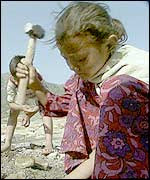
Many are unprotected by the lawThey are aged between 10 and 15, and are now learning how to play again and going through special trauma counselling.
The centre is run - not by the government, but by a charity, which often has to go to the courts to get a child freed from work.
Kailash Satyarthi of South Asian Coalition Against Child Labour said: "We see a massive abuse of human rights and labour rights in government contracted works. But the greyest area is the implementation of law".
Evidences
Evidence for this was clear when you consider the case of Sada Abhindar was making bricks near a police station.
The police saw him everyday but did nothing.
And until recently Surita Rania was working to pay off her father's loan.
She gathers firewood and breaks up quarry stones.
But when she got things wrong, they hit her hands with a metal rod.
In this vast country there are many more like Surita and Sada - lone children unprotected by the law।
Source: BBC NEWS World edition
http://news.bbc.co.uk/2/hi/south_asia/2206026.stm
India's child labour laws failing

Children are often victims of labour exploitation
By Humphrey Hawskley In Haryana state
India is coming under increasing pressure to take action over massive human rights abuses against child workers and indentured labourers.
Investigations show that it has more child labourers than any other country - and that millions of adult labourers still work in near slave like conditions - despite laws being passed to stop it.
For example, government-owned land is leased out for quarrying to private contractors - who are meant to have signed up to India's state of the art labour laws.
But the men working the sites have no safety gear at all, no helmets, shoes, masks, and claim that they are being paid only half of what they had been promised.
Victims opinion

Ram Yadav was until a few years ago a bonded labourer, condemned to work off a debt run up by his parents.
Many children have forgotten how to playHe was freed because a charity went to court on his behalf.
Now he goes round checking on conditions of other workers.
"I'm telling you, the laws are there for you, but the politicians and the mine owners get together to make sure you have to work under conditions which are no better than for animals," he says.
No serious safety equipment could be seen anywhere through the quarries.
Flaw in government
The finger of blame is firmly pointed at vested interests - including those in government - who are making money out of it - and therefore there is no political will to stop it.
India has world standard labour legislation, but in practice it has more slave and abused labourers than any other country.
The whole system is riddled with corruption, with politicians and contractors benefiting from it.
Amazingly VK Sharma, in the office of the local labour commission, agreed to the accusation.
Care centres
The allegation of government neglect in this issue becomes more stark at a near-by care centre for children who recently were victims of abusive labour.

Many are unprotected by the lawThey are aged between 10 and 15, and are now learning how to play again and going through special trauma counselling.
The centre is run - not by the government, but by a charity, which often has to go to the courts to get a child freed from work.
Kailash Satyarthi of South Asian Coalition Against Child Labour said: "We see a massive abuse of human rights and labour rights in government contracted works. But the greyest area is the implementation of law".
Evidences
Evidence for this was clear when you consider the case of Sada Abhindar was making bricks near a police station.
The police saw him everyday but did nothing.
And until recently Surita Rania was working to pay off her father's loan.
She gathers firewood and breaks up quarry stones.
But when she got things wrong, they hit her hands with a metal rod.
In this vast country there are many more like Surita and Sada - lone children unprotected by the law।
Source: BBC NEWS World edition
http://news.bbc.co.uk/2/hi/south_asia/2206026.stm
Monday, July 21, 2008
गंगा तेरा पानी अमृत झर -झर बहता जाए
युग -युग से इस देश की धरती तुझसे जीवन पाये गंगा तेरा पानी ...
दूर हिमालय से तू आई गीत सुहाने गाती बस्ती -बस्ती पर्वत -पर्वत सुख -संदेश सुनाती तेरी चांदी जैसी धारा मीलों तक लहराए गंगा तेरा पानी ...
कितने सूरज उभरे -दूबे गंगा तेरे द्वारे युगों -युगों की कथा सुनाएँ तेरे बहते धारे तुझको छोड़ के भारत का इतिहास लिखा न जाए गंगा तेरा पानी ...
इस धरती का दुःख -सुख तूने अपने बीच समोया जब -जब देश गुलाम हुआ है तेरा पानी रोया जब -जब हम आजाद हुए हैं तेरे तट मुसकाए गंगा तेरा पानी ...
युग -युग से इस देश की धरती तुझसे जीवन पाये गंगा तेरा पानी ...
दूर हिमालय से तू आई गीत सुहाने गाती बस्ती -बस्ती पर्वत -पर्वत सुख -संदेश सुनाती तेरी चांदी जैसी धारा मीलों तक लहराए गंगा तेरा पानी ...
कितने सूरज उभरे -दूबे गंगा तेरे द्वारे युगों -युगों की कथा सुनाएँ तेरे बहते धारे तुझको छोड़ के भारत का इतिहास लिखा न जाए गंगा तेरा पानी ...
इस धरती का दुःख -सुख तूने अपने बीच समोया जब -जब देश गुलाम हुआ है तेरा पानी रोया जब -जब हम आजाद हुए हैं तेरे तट मुसकाए गंगा तेरा पानी ...
Sunday, July 13, 2008
India's child labour laws failing
Children are often victims of labour exploitation
By Humphrey Hawskley In Haryana state
India is coming under increasing pressure to take action over massive human rights abuses against child workers and indentured labourers.
Investigations show that it has more child labourers than any other country - and that millions of adult labourers still work in near slave like conditions - despite laws being passed to stop it.
For example, government-owned land is leased out for quarrying to private contractors - who are meant to have signed up to India's state of the art labour laws.
But the men working the sites have no safety gear at all, no helmets, shoes, masks, and claim that they are being paid only half of what they had been promised.
Victims opinion
Ram Yadav was until a few years ago a bonded labourer, condemned to work off a debt run up by his parents.
Many children have forgotten how to playHe was freed because a charity went to court on his behalf.
Now he goes round checking on conditions of other workers.
"I'm telling you, the laws are there for you, but the politicians and the mine owners get together to make sure you have to work under conditions which are no better than for animals," he says.
No serious safety equipment could be seen anywhere through the quarries.
Flaw in government
The finger of blame is firmly pointed at vested interests - including those in government - who are making money out of it - and therefore there is no political will to stop it.
India has world standard labour legislation, but in practice it has more slave and abused labourers than any other country.
The whole system is riddled with corruption, with politicians and contractors benefiting from it.
Amazingly VK Sharma, in the office of the local labour commission, agreed to the accusation.
Care centres
The allegation of government neglect in this issue becomes more stark at a near-by care centre for children who recently were victims of abusive labour.
Many are unprotected by the lawThey are aged between 10 and 15, and are now learning how to play again and going through special trauma counselling.
The centre is run - not by the government, but by a charity, which often has to go to the courts to get a child freed from work.
Kailash Satyarthi of South Asian Coalition Against Child Labour said: "We see a massive abuse of human rights and labour rights in government contracted works. But the greyest area is the implementation of law".
Evidences
Evidence for this was clear when you consider the case of Sada Abhindar was making bricks near a police station.
The police saw him everyday but did nothing.
And until recently Surita Rania was working to pay off her father's loan.
She gathers firewood and breaks up quarry stones.
But when she got things wrong, they hit her hands with a metal rod.
In this vast country there are many more like Surita and Sada - lone children unprotected by the law।
Source: BBC NEWS
http://news.bbc.co.uk/2/hi/south_asia/2206026.stm
By Humphrey Hawskley In Haryana state
India is coming under increasing pressure to take action over massive human rights abuses against child workers and indentured labourers.
Investigations show that it has more child labourers than any other country - and that millions of adult labourers still work in near slave like conditions - despite laws being passed to stop it.
For example, government-owned land is leased out for quarrying to private contractors - who are meant to have signed up to India's state of the art labour laws.
But the men working the sites have no safety gear at all, no helmets, shoes, masks, and claim that they are being paid only half of what they had been promised.
Victims opinion
Ram Yadav was until a few years ago a bonded labourer, condemned to work off a debt run up by his parents.
Many children have forgotten how to playHe was freed because a charity went to court on his behalf.
Now he goes round checking on conditions of other workers.
"I'm telling you, the laws are there for you, but the politicians and the mine owners get together to make sure you have to work under conditions which are no better than for animals," he says.
No serious safety equipment could be seen anywhere through the quarries.
Flaw in government
The finger of blame is firmly pointed at vested interests - including those in government - who are making money out of it - and therefore there is no political will to stop it.
India has world standard labour legislation, but in practice it has more slave and abused labourers than any other country.
The whole system is riddled with corruption, with politicians and contractors benefiting from it.
Amazingly VK Sharma, in the office of the local labour commission, agreed to the accusation.
Care centres
The allegation of government neglect in this issue becomes more stark at a near-by care centre for children who recently were victims of abusive labour.
Many are unprotected by the lawThey are aged between 10 and 15, and are now learning how to play again and going through special trauma counselling.
The centre is run - not by the government, but by a charity, which often has to go to the courts to get a child freed from work.
Kailash Satyarthi of South Asian Coalition Against Child Labour said: "We see a massive abuse of human rights and labour rights in government contracted works. But the greyest area is the implementation of law".
Evidences
Evidence for this was clear when you consider the case of Sada Abhindar was making bricks near a police station.
The police saw him everyday but did nothing.
And until recently Surita Rania was working to pay off her father's loan.
She gathers firewood and breaks up quarry stones.
But when she got things wrong, they hit her hands with a metal rod.
In this vast country there are many more like Surita and Sada - lone children unprotected by the law।
Source: BBC NEWS
http://news.bbc.co.uk/2/hi/south_asia/2206026.stm
Friday, June 13, 2008
Evangelicals observe Anti-child Labor Day with prayers
June 13, 2008
NEW DELHI (ICNS): As the world is observed Anti-child Labor Day on June 12, Evangelical Fellowship of India Children At Risk (EFICAR) remembered the day seeking prayers for child labors.
The Evangelical group requested prayers for the “stringent implementation” of laws that ban child labor in India। It said such prayers are need so that people become aware of the legal provisions “so that our nation will become a better and safe place for children to live in.” In a message it said child labor is “the biggest” issue in India as the nation has 12.7 million child labors aged 5-14, which is “the highest in the world.” “Most of them work 10-13 hours a day. The number of child labors is increasing in the states like Sikkim, Nagaland and Himachal Pradesh where there was no trace of child labour some years back.”Indian Constitution says that no child below the age of 14 years shall be employed to work in any factory or mine or engaged in any other hazardous employment. India also enacted a law called child Labour (Prohibition & Regulation) Act, in 1986, which prohibits the employment of children below 14 years of age in hazardous industries, it noted. A notification issued in 2006 under the act prohibits the employment of children below 14 as domestic servants, in roadside stalls, restaurants, tea stalls, hotels, recreation centers. It also made provisions for punishing the violators. Yet the act remains ineffective effective in eradicating child labor from our society, the Evangelical Fellowship of India note said seeking prayers to create awareness in society.
Source: Indian Catholic
http://www.theindiancatholic.com/report.asp?nid=10470
NEW DELHI (ICNS): As the world is observed Anti-child Labor Day on June 12, Evangelical Fellowship of India Children At Risk (EFICAR) remembered the day seeking prayers for child labors.
The Evangelical group requested prayers for the “stringent implementation” of laws that ban child labor in India। It said such prayers are need so that people become aware of the legal provisions “so that our nation will become a better and safe place for children to live in.” In a message it said child labor is “the biggest” issue in India as the nation has 12.7 million child labors aged 5-14, which is “the highest in the world.” “Most of them work 10-13 hours a day. The number of child labors is increasing in the states like Sikkim, Nagaland and Himachal Pradesh where there was no trace of child labour some years back.”Indian Constitution says that no child below the age of 14 years shall be employed to work in any factory or mine or engaged in any other hazardous employment. India also enacted a law called child Labour (Prohibition & Regulation) Act, in 1986, which prohibits the employment of children below 14 years of age in hazardous industries, it noted. A notification issued in 2006 under the act prohibits the employment of children below 14 as domestic servants, in roadside stalls, restaurants, tea stalls, hotels, recreation centers. It also made provisions for punishing the violators. Yet the act remains ineffective effective in eradicating child labor from our society, the Evangelical Fellowship of India note said seeking prayers to create awareness in society.
Source: Indian Catholic
http://www.theindiancatholic.com/report.asp?nid=10470
Thursday, June 12, 2008
World Day Against Child Labour for working child
The ILO has declared June 12 as the World Day Against Child Labour that is observed across the world. We should create awareness among parents that children need quality education and proper training for acquiring skills necessary to succeed in life..
CJ: Md Mudassir Alam , 18 hours ago Views:261 Comments:0
FAMOUS ENGLISH poet William Wordsworth once said, “The Child is the father of the Man.” With the time, the quote lost its significance and now hardly anyone cares about the saying of Wordsworth. Gruesome fact is that today the wealth of parents decide the fortune of the children whether they will enjoy the luxurious amenities or work from the childhood to earn bread. Nowadays children have been used for domestic work, mining, agriculture and other hard works. Besides, millions of children work for long hours in factories, mostly in dangerous conditions. These children are unaware about the liberty of childhood and suffer from the cruel trend generated by civilised society.
For those unlucky children living in misery, the International Labour Organisation (ILO) has declared June 12 as World Day Against Child Labour, which is observed across the world. Sadly the day is not popular as Valentine Day, Friendship Day or other celebrated day, but the concerned people across the world give importance to this day and observe with great enthusiasm. Non-government organisations, human right activists and other social welfare organisations work at their best to spread awareness among common people related to child labour.
According the ILO estimate, about 165 million children between the ages of five and 14 are involved in child labour across the world. Usually each year on World Day Against Child Labour, the ILO focusses on one of the ’Worst Forms of Child labour’ listed in Convention No 182. Like many countries in the world, child labour condition is also very bad in India. World’s second largest most populated country, India has the highest number of child labour of the world. Despite the strict laws, the child labour is increasing day-by-day in India. A number of reasons are behind the huge number of child labour in India. Poverty and illiteracy are the main reasons behind the increasing number of child labours in India. Generally poor parents encourage their children to earn money by working instead of sending them to school. Traditionally, girls suffer more from boys, as parents prefer the boys to send school and send girls to work for household works. At the same time, rich people and owners of factories never think about the health and freedom of the children.
Seeing the continuous growth in the number of child labour across the world the United Nations (UN) and the broader international community have set up the Millennium Development Goals. The community has set the target that by the year 2015, all boys and girls will complete a full course of primary education with gender parity. However, these targets cannot be fulfilled unless the factors that generate
child labour and prevent poor families from sending their children to school are addressed.
On this important day, we should at least think about the possible ways to stop the child labour and save the children who are future of nation। We should create awareness among the parents that children need a good quality education and proper training for acquiring the skills necessary to succeed in the labour market. Last but not the least, those who hire children for work should think whether they will allow their children to do the same work. If such thinking will develop in the society then the evil of child labour can be removed from the world.
Source : World Meri News
http://world.merinews.com/catFull.jsp?articleID=135615
CJ: Md Mudassir Alam , 18 hours ago Views:261 Comments:0
FAMOUS ENGLISH poet William Wordsworth once said, “The Child is the father of the Man.” With the time, the quote lost its significance and now hardly anyone cares about the saying of Wordsworth. Gruesome fact is that today the wealth of parents decide the fortune of the children whether they will enjoy the luxurious amenities or work from the childhood to earn bread. Nowadays children have been used for domestic work, mining, agriculture and other hard works. Besides, millions of children work for long hours in factories, mostly in dangerous conditions. These children are unaware about the liberty of childhood and suffer from the cruel trend generated by civilised society.
For those unlucky children living in misery, the International Labour Organisation (ILO) has declared June 12 as World Day Against Child Labour, which is observed across the world. Sadly the day is not popular as Valentine Day, Friendship Day or other celebrated day, but the concerned people across the world give importance to this day and observe with great enthusiasm. Non-government organisations, human right activists and other social welfare organisations work at their best to spread awareness among common people related to child labour.
According the ILO estimate, about 165 million children between the ages of five and 14 are involved in child labour across the world. Usually each year on World Day Against Child Labour, the ILO focusses on one of the ’Worst Forms of Child labour’ listed in Convention No 182. Like many countries in the world, child labour condition is also very bad in India. World’s second largest most populated country, India has the highest number of child labour of the world. Despite the strict laws, the child labour is increasing day-by-day in India. A number of reasons are behind the huge number of child labour in India. Poverty and illiteracy are the main reasons behind the increasing number of child labours in India. Generally poor parents encourage their children to earn money by working instead of sending them to school. Traditionally, girls suffer more from boys, as parents prefer the boys to send school and send girls to work for household works. At the same time, rich people and owners of factories never think about the health and freedom of the children.
Seeing the continuous growth in the number of child labour across the world the United Nations (UN) and the broader international community have set up the Millennium Development Goals. The community has set the target that by the year 2015, all boys and girls will complete a full course of primary education with gender parity. However, these targets cannot be fulfilled unless the factors that generate
child labour and prevent poor families from sending their children to school are addressed.
On this important day, we should at least think about the possible ways to stop the child labour and save the children who are future of nation। We should create awareness among the parents that children need a good quality education and proper training for acquiring the skills necessary to succeed in the labour market. Last but not the least, those who hire children for work should think whether they will allow their children to do the same work. If such thinking will develop in the society then the evil of child labour can be removed from the world.
Source : World Meri News
http://world.merinews.com/catFull.jsp?articleID=135615
Wednesday, June 11, 2008
Missing, A Strong Legal Framework To Combat Child Labour

Wednesday 11th of June 2008The numbers tell the sorry story - an estimated 60 million child labourers in India but only 670,000 violations of the law detected in eight years and just 22,588 convictions!Behind the bland government numbers are the millions of young children working in roadside eateries, slaving away in glass factories, hunched up over carpet looms or sweeping and cooking in homes in blatant violation of the Child Labour (Prohibition and Regulation) Act।The children are a visible proof of the failure to implement the law, the inbuilt lacunae in the legislation itself and the poor rehabilitation policies.Although government figures put the number of child labourers in the country at 1.5 million, child rights activists say the number is closer to 60 million.The low conviction rate in the eight years during 1997-98 to 2005-06, as indicated by the annual report of the ministry of labour 2007-08, gives a clear signal that the law has failed to act as a deterrent to stop child labour, say experts.'The number of people convicted because of flouting the law and hiring children as labourers is very low. According to a study by the V.V. Giri National Labour Institute (a body of the ministry of labour and employment) in 2003, for instance, 14,163 inspections were done with respect to enforcement of the Child Labour Act. However, the number of convictions was only 99,' Pradeep Narayanan of CRY India told IANS.Kailash Satyarthi of the Bachpan Bachao Aandolan (Save Childhood Movement) added that judgements against those flouting the law on child labour were rare; hardly anyone has been jailed for two years for an offence under the law prohibiting child labour.For first convictions, the act prescribes imprisonment of three to 12 months or a fine of Rs.10,000-20,000 ($250-500). Second offences are to be punished with a mandatory six months to two years in prison.While implementation of the law is one problem, the legal framework is also not strong enough.According to Narayanan, the law, which bans the employment of children under 14, itself has many limitations.'According to the Child Labour (Prohibition and Regulation) Act, children below the age of 14 should not be employed in factories and hazardous occupations. Nowhere does it mention the agriculture sector, where 70-80 percent of the child labourers are employed for cheap labour,' Narayanan told IANS.Another reason why there seems to be no end to the vicious cycle of child labour is the poor rehabilitation policies of the rescued child labourers.The economic context that forces the children to work or face starvation is vital, say experts. What is needed is holistic rehabilitation.In a conference earlier this year, Dipa Dixit, member of the National Commission of Protection of Child Rights (NCPCR), pointed to the deplorable condition of juvenile homes where rescued child labourers are taken to. Instead of helping matters, they just drive the children back to the roads, she said.Mahmun, a 15-year-old rescued child labourer, said: 'The juvenile homes are like jails. I was picked up from a railway station and put into a juvenile home in Lajpat Nagar (in south Delhi) where I used to be beaten up almost every day along with other children.'Forget about love and care, the caretakers used to take back the clothes that we used to get and purchased things like cigarettes and tobacco. Frustrated, I used to escape from all these homes and go back to the roads.'The National Child Labour Project (NCLP), which acts a bridge school for rescued child labourers and is run by the ministry of labour, has been functioning for the past 20 years but without much gain.As a possible solution, Satyarthi suggests that all programmes such the NCLP, the Sarva Shiksha Abhiyan and the midday meal scheme be clubbed together and the responsibility of their implementation be given to one officer in every district -- to begin with in 100 districts.Experts also suggest the implementation of more officials and labour inspectors and not looking at the issue of child labour in isolation.'Poverty is the main reason which drives parents into pushing their children to work instead of sending them to schools. Addressing that is one of the main challenges to resolving this mammoth problem,' Satyarthi told IANS.As India stares at another global day against child labour, perhaps it is time to finally take up the challenge.(Azera Rahman can be contacted at azera.p@ians.in)
Source: News Post India
http://newspostindia.com/report-59956
Source: News Post India
http://newspostindia.com/report-59956
Monday, June 9, 2008
ठेकेदारी समाज के लिए कुष्ठ रोग
आज ठेकेदारी एक बहूत बड़ी समस्या बन गई है । ये एक कुष्ठ रोग के जैसे समाज पर असर कर रही है। नासूर बन गई है लोगों के लिए ठेकेदारी एक ऐसी कार्य पधती है जो की केवल पूंजीपतियों का ही लाभ कराती और गरीबों का खून चुस्तीहै। जिसके कारन गरीब लोगका समाज और भी गरीब होता जा रहा है क्योंकि उनकी सुनाने बाला कोई नहीं है न ही सरकारें सुनती है न और कोई इसकी जिम्मेदारी लेने वाला कोई नही है ठेकेदार थोड़े से पैसे देकर उनकी झमता और उस पैसे की कीमत से भी जायदा काम कराने के लिए प्रयासरत रहते है उन्हें सिर्फ़ अपने लाभ के आगे किसी की भी गरीब की परवाह नही होती है ।
और न ही ठेकेदारी से मज्दोरों का भविष्य सुरझित है जब तक उनके शरीर में शक्ति है तब तक वो थोड़ा सा पैसा पाकर अपना जीवन जीत हैं । वो भी जानवरों की तरह उनका कोई भी रिकोर्ड भी नहीं होता और रिकोर्ड होता भी है तो ठेकेदारों के पास उससे वो अपनी मर्जी का कम करते हैं
अब तो मज्दुओं के पास साबुत नम की कोई चीज भी छोड़ते जैसे की वेतन की पर्ची इ एस आई सी , पी ऍफ़ , परिचय पत्र इत्यादी । इन सब चीजों के बिना कोई भी कम्पनी या ठेकेदार उनको आसानी से कभी नौकरी से निकल सकते हैं और वो बिना साबुत के अदालत में भी नहीं जा सकते क्योंकि अदालत में भी उनकी बिना साबुत के कोई सुनाने बाला कोई नही है । ऐसे वो मजदुर लोग अपनी बेकार से नौकरी छोड़ कर भी काफी परशानी में आजाते हैं क्योंकि वो कर्ज में तो उसी समय से दुबे होते हैं जबकि बो नौकरी कर रहे थे। अब उनके पास कोई भी चारा नहीं है ।
ऐसी दसा में वो लोग भी परेशां करते हैं जिनका पैसा लेकर मजदूर अपना कम चलाते थे । कभी-२ ऐसी परीस्थितियों में काफी मजदुर आत्म हत्या कर लेते हैं । या दूसरे ग़लत लोगो के बहेकाबे में आकर वो किसी ग़लत कार्य को अंजाम देते है जैसे की चोरी, डकैती , अपहरण , हत्या और भी कई प्रकार के अपराधों को बढ़ाबा मिलता है इस ठेकेदारी कारण और अंत में मजदूरों का जीवन नरक हो जाता है और उनके बच्चों की शिक्षा, पालन पोषण और उनसे सम्भंधित सभी चीजों में बढ़ा आती है
काफी कंपनिओं में तो ऐसा होता है की मजदुर अपना पुरा जीवन उस कम्पनी में कार्य करते हुए व्यतीत कर देते हैं जब उनका अन्तिम समय है ब्रधावस्था होती तब कम्पनी से निकल देते है ।
आज ठेकेदारी एक बहूत बड़ी समस्या बन गई है । ये एक कुष्ठ रोग के जैसे समाज पर असर कर रही है। नासूर बन गई है लोगों के लिए ठेकेदारी एक ऐसी कार्य पधती है जो की केवल पूंजीपतियों का ही लाभ कराती और गरीबों का खून चुस्तीहै। जिसके कारन गरीब लोगका समाज और भी गरीब होता जा रहा है क्योंकि उनकी सुनाने बाला कोई नहीं है न ही सरकारें सुनती है न और कोई इसकी जिम्मेदारी लेने वाला कोई नही है ठेकेदार थोड़े से पैसे देकर उनकी झमता और उस पैसे की कीमत से भी जायदा काम कराने के लिए प्रयासरत रहते है उन्हें सिर्फ़ अपने लाभ के आगे किसी की भी गरीब की परवाह नही होती है ।
और न ही ठेकेदारी से मज्दोरों का भविष्य सुरझित है जब तक उनके शरीर में शक्ति है तब तक वो थोड़ा सा पैसा पाकर अपना जीवन जीत हैं । वो भी जानवरों की तरह उनका कोई भी रिकोर्ड भी नहीं होता और रिकोर्ड होता भी है तो ठेकेदारों के पास उससे वो अपनी मर्जी का कम करते हैं
अब तो मज्दुओं के पास साबुत नम की कोई चीज भी छोड़ते जैसे की वेतन की पर्ची इ एस आई सी , पी ऍफ़ , परिचय पत्र इत्यादी । इन सब चीजों के बिना कोई भी कम्पनी या ठेकेदार उनको आसानी से कभी नौकरी से निकल सकते हैं और वो बिना साबुत के अदालत में भी नहीं जा सकते क्योंकि अदालत में भी उनकी बिना साबुत के कोई सुनाने बाला कोई नही है । ऐसे वो मजदुर लोग अपनी बेकार से नौकरी छोड़ कर भी काफी परशानी में आजाते हैं क्योंकि वो कर्ज में तो उसी समय से दुबे होते हैं जबकि बो नौकरी कर रहे थे। अब उनके पास कोई भी चारा नहीं है ।
ऐसी दसा में वो लोग भी परेशां करते हैं जिनका पैसा लेकर मजदूर अपना कम चलाते थे । कभी-२ ऐसी परीस्थितियों में काफी मजदुर आत्म हत्या कर लेते हैं । या दूसरे ग़लत लोगो के बहेकाबे में आकर वो किसी ग़लत कार्य को अंजाम देते है जैसे की चोरी, डकैती , अपहरण , हत्या और भी कई प्रकार के अपराधों को बढ़ाबा मिलता है इस ठेकेदारी कारण और अंत में मजदूरों का जीवन नरक हो जाता है और उनके बच्चों की शिक्षा, पालन पोषण और उनसे सम्भंधित सभी चीजों में बढ़ा आती है
काफी कंपनिओं में तो ऐसा होता है की मजदुर अपना पुरा जीवन उस कम्पनी में कार्य करते हुए व्यतीत कर देते हैं जब उनका अन्तिम समय है ब्रधावस्था होती तब कम्पनी से निकल देते है ।
Subscribe to:
Posts (Atom)

